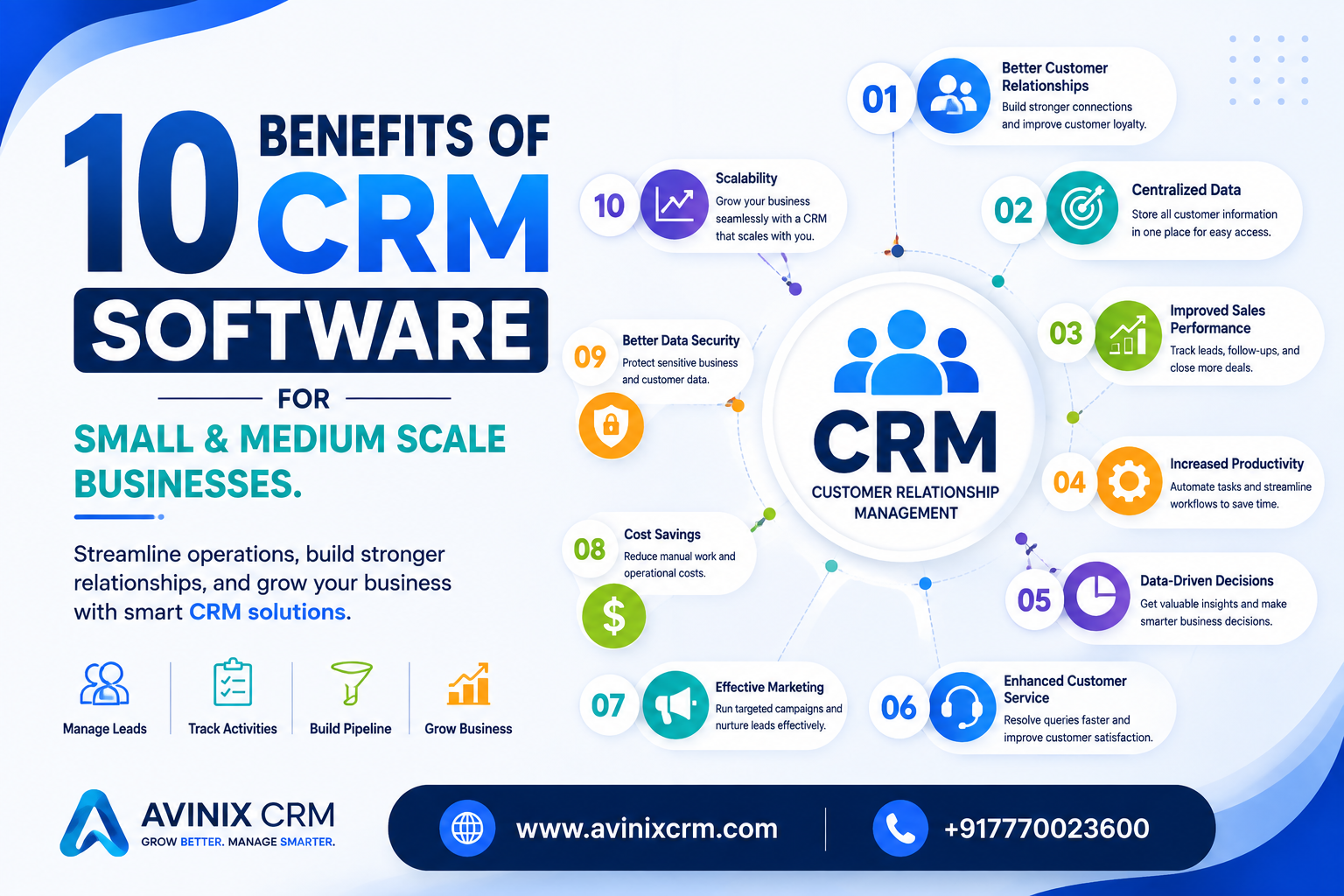
10 Benefits of CRM Software for Small & Medium Scale Businesses.
Running a small or medium-sized business involves much more than finding customers and making sales. Businesses need to generate leads, respond to inquiries, schedule follow-ups, manage sales opportunities, communicate with customers, coordinate teams, and make informed decisions based on accurate data.
As a business grows, managing all of these activities using spreadsheets, notebooks, WhatsApp chats, emails, and scattered documents can quickly become difficult.
This is where CRM software can make a significant difference.
CRM, or Customer Relationship Management, software provides a centralized system for managing leads, customers, sales activities, communication, follow-ups, and team performance.
For small and medium businesses, a CRM can help create a more organized sales process without requiring a large sales operations team.
Modern CRM platforms such as Avinix CRM bring lead management, sales pipelines, follow-ups, tasks, WhatsApp conversations, team management, and reporting together in one platform.
Let's explore the 10 major benefits of using CRM software for small and medium businesses.
1. Better Lead Management
Leads are the foundation of every growing business. However, generating leads is only the first step. Businesses also need to organize, assign, qualify, follow up with, and convert those leads.
Without a CRM, lead information can become scattered across:
- Excel or Google Sheets
- WhatsApp conversations
- Email inboxes
- Phone contacts
- Paper notes
- Individual sales representatives' devices
This makes it difficult to know which leads are new, which have been contacted, which require follow-up, and which are close to becoming customers.
A CRM provides a centralized location for managing leads.
With Avinix CRM, businesses can capture leads from multiple sources, assign leads to appropriate team members, monitor lifecycle stages, and maintain activity history.
Why this matters for SMEs
A structured lead management process helps businesses:
- Reduce lost leads
- Improve response management
- Assign leads to the right salesperson
- Track lead status
- Maintain customer history
- Improve sales team accountability
Instead of asking, "What happened to this lead?", your team can simply check the CRM.
2. Never Miss Important Follow-Ups
One of the biggest reasons businesses lose potential customers is not necessarily poor products or pricing—it is missed or delayed follow-ups.
A salesperson may speak to a prospect today and plan to call again after three days. Without a proper system, that follow-up can easily be forgotten.
CRM software helps turn follow-ups into an organized process.
You can create tasks, reminders, meetings, and follow-up activities connected to specific leads or opportunities.
Avinix CRM provides task management and calendar functionality that allows sales teams to create and assign tasks, organize meetings, and connect activities with leads and opportunities.
The result?
Your sales team can spend less time remembering what needs to be done and more time actually selling.
3. Improve Sales Pipeline Visibility
For a business owner or sales manager, one of the most important questions is:
"How many sales opportunities do we currently have, and where are they in the sales process?"
A CRM sales pipeline provides a visual overview of your opportunities.
Instead of maintaining a spreadsheet with dozens or hundreds of leads, your team can see prospects moving through stages such as:
New Lead → Contacted → Qualified → Follow-Up → Proposal → Negotiation → Won/Lost
Avinix CRM provides a Kanban-style sales pipeline that allows businesses to track opportunities, customize sales stages, monitor pipeline value, and identify bottlenecks.
Why pipeline visibility is important
It helps managers understand:
- How many opportunities are active
- Which deals are close to conversion
- Which opportunities are stuck
- How much business is in the pipeline
- Where sales representatives need support
This makes sales management much more proactive.
4. Increase Sales Team Productivity
Sales representatives often spend considerable time performing administrative activities:
- Updating spreadsheets
- Searching for customer information
- Checking WhatsApp conversations
- Remembering follow-ups
- Preparing reports
- Updating managers
- Searching through old messages
A CRM centralizes much of this information.
Instead of switching between multiple tools, sales representatives can manage leads, activities, opportunities, tasks, and customer information from one platform.
Avinix CRM also allows managers to assign leads, monitor activities, track task completion, and review team productivity.
More organization means more selling time
When salespeople spend less time managing scattered information, they can focus more on:
- Calling prospects
- Conducting meetings
- Sending proposals
- Building relationships
- Closing deals
5. Centralize Customer Communication
Modern customers communicate through multiple channels.
A customer may initially call your business, continue the conversation through WhatsApp, receive an email, and later speak with another salesperson.
If this communication is not properly organized, important information can easily get lost.
A CRM helps create a centralized customer record where sales teams can understand the history of interactions.
For businesses that rely heavily on WhatsApp, integrating WhatsApp with CRM can be particularly valuable.
Avinix CRM supports official Meta WhatsApp Business integration, centralized chat history, customer conversations, and structured broadcasts.
Benefits of centralized communication
Your team can:
- View previous conversations
- Understand customer requirements
- Respond faster
- Reduce repetitive questions
- Maintain communication history
- Provide a more consistent customer experience
This is especially useful when multiple team members interact with the same customer.
6. Improve Team Accountability
As a business grows, the owner cannot personally monitor every lead and every sales conversation.
This creates a need for better visibility into team activities.
CRM software allows managers to understand:
- Who owns each lead
- Which leads have been contacted
- Which follow-ups are pending
- How many opportunities each salesperson manages
- Which deals have been won or lost
- Where sales activities are slowing down
Avinix CRM includes team management and performance tracking features that help managers monitor lead ownership, follow-up activities, opportunities, pipeline value, and individual or team performance.
Why accountability matters
When responsibilities are clearly assigned, it becomes easier to identify:
Who is responsible? → What needs to be done? → When should it happen? → What was the outcome?
This creates a more disciplined sales process.
7. Make Better Business Decisions With Data
Many small businesses make sales decisions based on assumptions.
For example:
- "I think our sales are improving."
- "We probably have enough leads."
- "This salesperson seems to be performing well."
- "Most of our customers come from referrals."
Without accurate data, these assumptions may not always be correct.
CRM software provides business owners with access to structured sales information.
You can analyze metrics such as:
- Total leads
- Qualified leads
- Open opportunities
- Follow-ups
- Won deals
- Lost deals
- Pipeline value
- Sales team performance
Avinix CRM provides dashboards for monitoring these types of sales and team metrics.
Data helps answer important questions
For example:
Which lead source generates the best customers?
Which salesperson converts the most opportunities?
Where are deals getting stuck?
How much business is currently in the pipeline?
How many leads are being followed up?
These insights can help business owners make more informed decisions.
8. Improve Customer Experience
Customers expect businesses to remember their conversations, requirements, and previous interactions.
Imagine a customer contacts your business after speaking with a salesperson last week.
If the new representative has no access to the previous conversation, the customer may have to explain everything again.
That creates friction.
With CRM software, customer information and interaction history can be organized in one place.
Sales teams can quickly understand:
- Who the customer is
- What they are interested in
- Previous conversations
- Follow-up history
- Current sales stage
- Tasks associated with the customer
- Previous activities
This enables a more consistent and professional customer experience.
9. Reduce Dependence on Spreadsheets and Scattered Tools
Spreadsheets can be useful when a business is starting out.
However, as the number of leads and employees increases, spreadsheets can become difficult to manage.
Common problems include:
- Duplicate entries
- Incorrect information
- Missing updates
- Accidental deletion
- Multiple versions of the same file
- Difficult collaboration
- Limited visibility
- Manual reporting
CRM software provides a purpose-built system for managing customer and sales information.
Instead of maintaining separate systems for leads, pipeline tracking, tasks, and communication, businesses can bring these activities into one centralized platform.
Avinix CRM is designed around this all-in-one approach, combining leads, pipelines, follow-ups, tasks, WhatsApp, team management, and reporting.
10. Build a Scalable Sales Process
One of the biggest advantages of CRM software is that it helps businesses create repeatable processes.
A business may start with two salespeople and 50 leads per month.
As it grows, it may have:
- 10+ sales representatives
- Hundreds or thousands of leads
- Multiple sales pipelines
- Different departments
- Multiple locations
- More customer conversations
- More managers
A manual process that worked for a small team may not work at this scale.
CRM software provides a structured foundation that can grow with the business.
Avinix CRM supports custom fields, custom views, flexible pipelines, and multiple workspaces, allowing businesses to adapt the CRM to different teams, departments, projects, or sales operations.
CRM is not just about managing today's sales
It is about creating a system that can support tomorrow's growth.
CRM Software vs. Traditional Sales Management
Many small businesses still manage their sales process using a combination of spreadsheets, WhatsApp, phone calls, emails, and notebooks.
Here's how a CRM-based approach differs:
| Traditional Approach | CRM-Based Approach |
|---|---|
| Leads stored in spreadsheets | Centralized lead management |
| Follow-ups remembered manually | Tasks and reminders |
| Sales tracked manually | Visual sales pipeline |
| WhatsApp conversations scattered | Centralized WhatsApp communication |
| Manual team reporting | Performance dashboards |
| Customer information across multiple tools | Centralized customer history |
| Difficult to identify bottlenecks | Pipeline visibility |
| Decisions based on assumptions | Data-driven decisions |
The objective isn't simply to replace spreadsheets.
The bigger objective is to create a structured, measurable, and repeatable sales process.
Who Should Use CRM Software?
CRM software can be useful for almost any business that regularly manages leads and customers.
It can be particularly valuable for:
Start-ups
Start-ups can establish an organized sales process from the beginning instead of building complicated manual systems that become difficult to manage later.
Small Businesses
Small businesses can organize leads, follow-ups, customer communication, and sales activities without requiring a large sales operations department.
Medium-Sized Businesses
Medium-sized businesses can improve collaboration between sales representatives and managers while gaining greater visibility into pipeline performance.
Sales Teams
Sales teams can manage leads, tasks, conversations, opportunities, and follow-ups from a centralized platform.
Service Businesses
Businesses that depend on inquiries, consultations, appointments, and recurring customer communication can use CRM software to organize their customer journey.
How to Choose the Right CRM for Your Small Business
Not every CRM is suitable for every business.
Before selecting CRM software, consider the following factors:
1. Ease of Use
Your sales team should be able to learn the system quickly.
A complicated CRM that employees don't use consistently will not deliver much value.
2. Lead Management
Make sure the CRM can capture, assign, organize, and track leads throughout the customer journey.
3. Sales Pipeline
Look for customizable pipeline stages that match your actual sales process.
4. Follow-Up Management
Tasks, reminders, calendars, and activity tracking can help prevent missed opportunities.
5. Communication Integration
If your business relies heavily on WhatsApp, consider a CRM that integrates customer communication into the sales workflow.
6. Reporting
Business owners and managers should be able to see meaningful sales and team performance information.
7. Customization
Every business has different requirements. Custom fields, views, pipelines, and workspaces can make a CRM more adaptable.
8. Scalability
Choose a platform that can continue supporting your business as your team and customer base grow.
Why CRM Is Becoming Essential for Growing Businesses
Competition is increasing across almost every industry.
Customers have more choices, sales cycles can become longer, and businesses need to respond quickly to inquiries.
At the same time, business owners need better visibility into what is happening inside their sales operation.
This makes CRM software more than just a customer database.
A modern CRM can become the central operating system for your sales process.
It can help your business move from:
Scattered data → Organized information
Missed follow-ups → Structured follow-ups
Unclear sales status → Visible pipeline
Manual reporting → Data-driven decisions
Individual sales processes → Standardized workflows
Start Managing Your Sales Process More Effectively
For small and medium businesses, growth often creates a new challenge: managing increasing numbers of leads, customers, employees, and sales activities.
A CRM can help solve this challenge by bringing essential sales operations into one organized platform.
The 10 key benefits include:
- Better lead management
- Fewer missed follow-ups
- Improved sales pipeline visibility
- Higher sales team productivity
- Centralized customer communication
- Better team accountability
- Data-driven business decisions
- Improved customer experience
- Less dependence on spreadsheets
- A scalable sales process
If your business is still managing leads and follow-ups across spreadsheets, notebooks, phone contacts, and separate messaging tools, it may be time to consider a dedicated CRM.
Avinix CRM is built for start-ups, SMEs, growing businesses, and sales teams, with features for lead management, sales pipelines, follow-ups, WhatsApp communication, tasks, team management, reporting, and customizable workflows.
Ready to Organize Your Sales Process?
Discover how Avinix CRM can help your business manage leads, follow-ups, sales opportunities, customer conversations, and team activities from one platform.
Call for free demo : +91 77700 23600
Start managing your leads smarter. Improve your follow-ups. Build a more organized sales process with Avinix CRM.